The Long Story
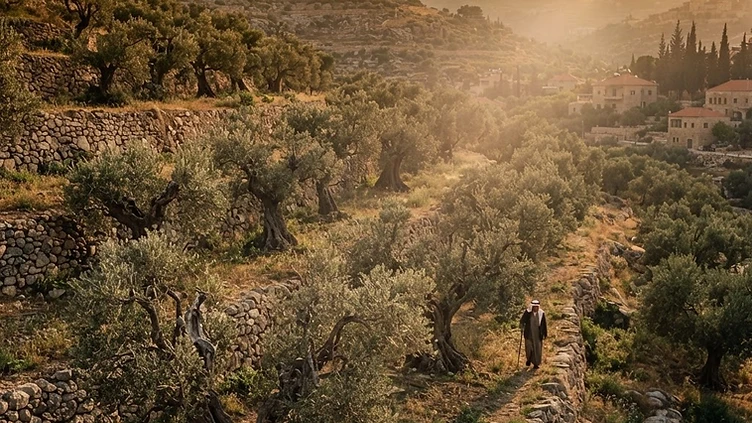
The story of Palestine begins long before any modern border. Archaeological evidence places continuous human settlement in the Jordan Valley as early as 9000 BCE, and Jericho is widely regarded among the oldest continuously inhabited cities on Earth. By the Bronze Age, Canaanite city-states had established the region's first urban civilization, building fortified towns, developing an alphabet, and trading olive oil, wine, and pottery across the eastern Mediterranean.
Around 1200 BCE, the peoples the Egyptians called the Peleset — the Philistines — settled the southern coastal plain, giving the land the name that would endure for three millennia: Palestine. Their cities of Gaza, Ashkelon, Ashdod, Ekron, and Gath formed a sophisticated pentapolis that traded with Egypt, Phoenicia, and the Aegean. Successive empires — Assyrian, Babylonian, Persian, Hellenistic, and Roman — swept over the land, each adding a layer to its culture while the underlying population remained, tending the same terraces and the same groves.
Under Roman and Byzantine rule, Palestine became a center of monotheism. The 7th century brought the Arab-Muslim conquest, and Jerusalem became the third holiest city of Islam, crowned by the Dome of the Rock — a gilded shrine that has defined the city's skyline for more than thirteen centuries. For nearly five hundred years under Ottoman administration, Palestine was a tapestry of Muslim, Christian, and Jewish communities living among the ancient stone of Jerusalem, Hebron, Nablus, and Gaza.
The 20th century shattered that continuity. British mandate, the 1948 Nakba, and decades of occupation and exile dispersed much of the Palestinian people, yet the bond to the land was never broken. The olive tree — some of whose roots predate the empires themselves — became the emblem of that unsevered belonging: rooted, patient, and renewed each season. Today, from the highlands of Ramallah to the coast of Gaza, from the camps of the diaspora to the rooftops of Jerusalem, the story of Palestine continues to be written by those who remember it, name it, and refuse to let it be forgotten.